Orientation
What problem the lesson solves, what vocabulary matters, and what a beginner should ignore for now.
 Math Logic Code
PDF book$25 instant signed download
Math Logic Code
PDF book$25 instant signed download
A guided AI engineering course with executed practice projects across NumPy, pandas, evaluation metrics, scikit-learn, neural-network math, PyTorch, NLP, embeddings, transformers, RAG, scaling, cost, and MLOps.
Why readers buy it
A project-based path from data foundations to modern AI engineering, with code/output traces and practical checkpoints.
AI Engineering Essentials is designed as a practical bridge from ordinary programming curiosity into real AI system building. It does not begin by assuming advanced mathematics, university machine learning, or prior production experience. The book starts with visible data, small Python programs, tables, arrays, and metrics, then turns each new AI idea into a runnable experiment you can inspect. The goal is not to memorize buzzwords; the goal is to understand what the data looks like, what the model is being asked to do, how the output is measured, and how to make one safe improvement at a time.
Core promise
"Read the data shape, name the transformation, predict the metric or output, then change one detail safely."
Each PDF is a direct purchase. Stripe confirms payment, the server records the book purchase, and the confirmation page prepares a private signed PDF download link.
Educational method
The Essentials method teaches AI by making every hidden step visible. A concept is introduced in plain language, translated into code, run with exact output, then checked with questions that ask you to predict what changed. Instead of dropping the reader into abstract formulas, the lessons build intuition from shapes, counts, comparisons, error measurements, and repeated experiments. Basic arithmetic is enough to begin: addition, subtraction, multiplication, division, percentages, and a willingness to follow a small program line by line.
Lesson structure
What problem the lesson solves, what vocabulary matters, and what a beginner should ignore for now.
Inspect rows, columns, arrays, labels, tokens, embeddings, or prompts before touching the algorithm.
Copy, execute, and read the exact output so the idea becomes observable rather than theoretical.
Connect a metric, loss value, prediction, retrieval result, or model response back to the code that produced it.
Adjust a feature, parameter, prompt, chunk size, model choice, or evaluation rule and explain the consequence.
Answer short questions, repair common mistakes, and summarize the practical engineering habit you just learned.
Inside the PDF
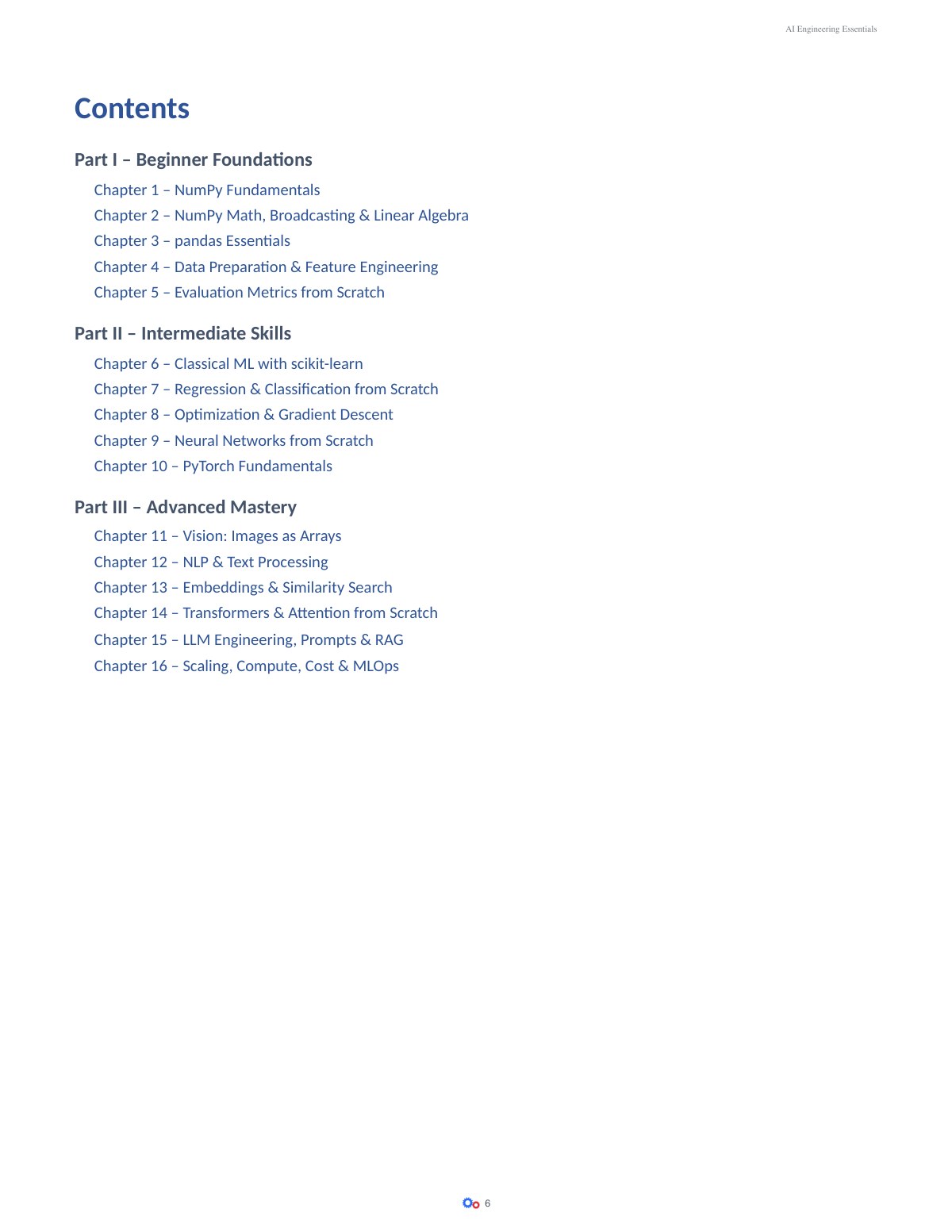
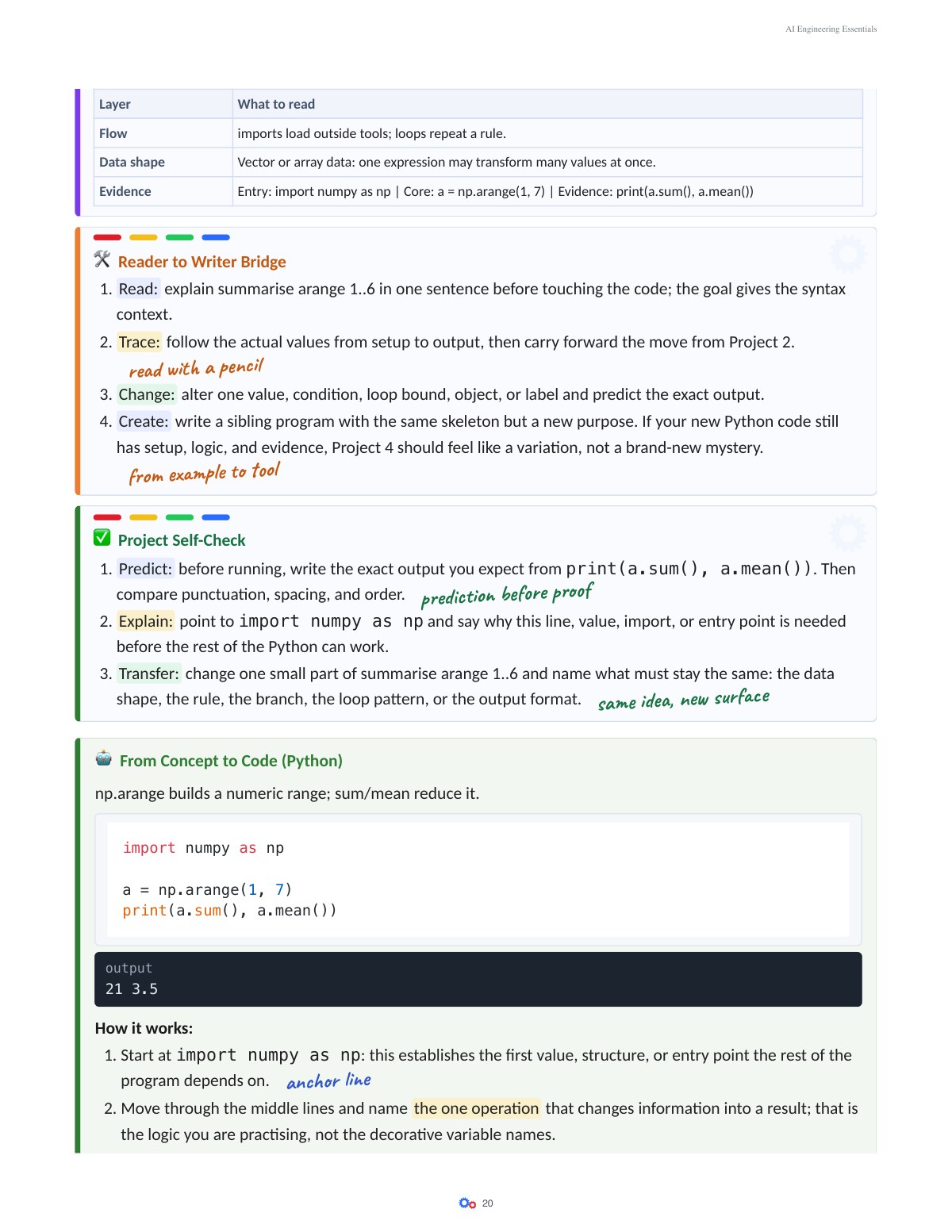
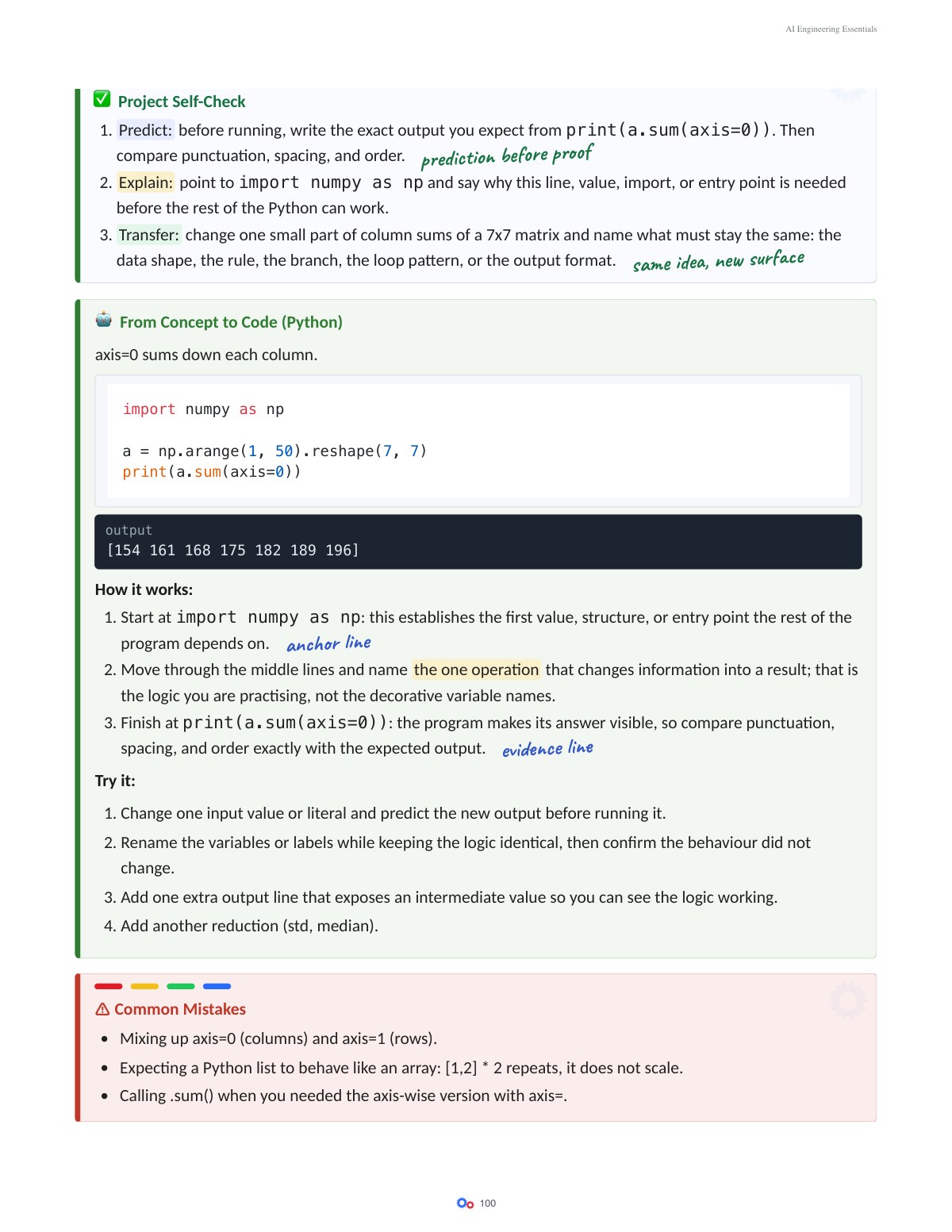
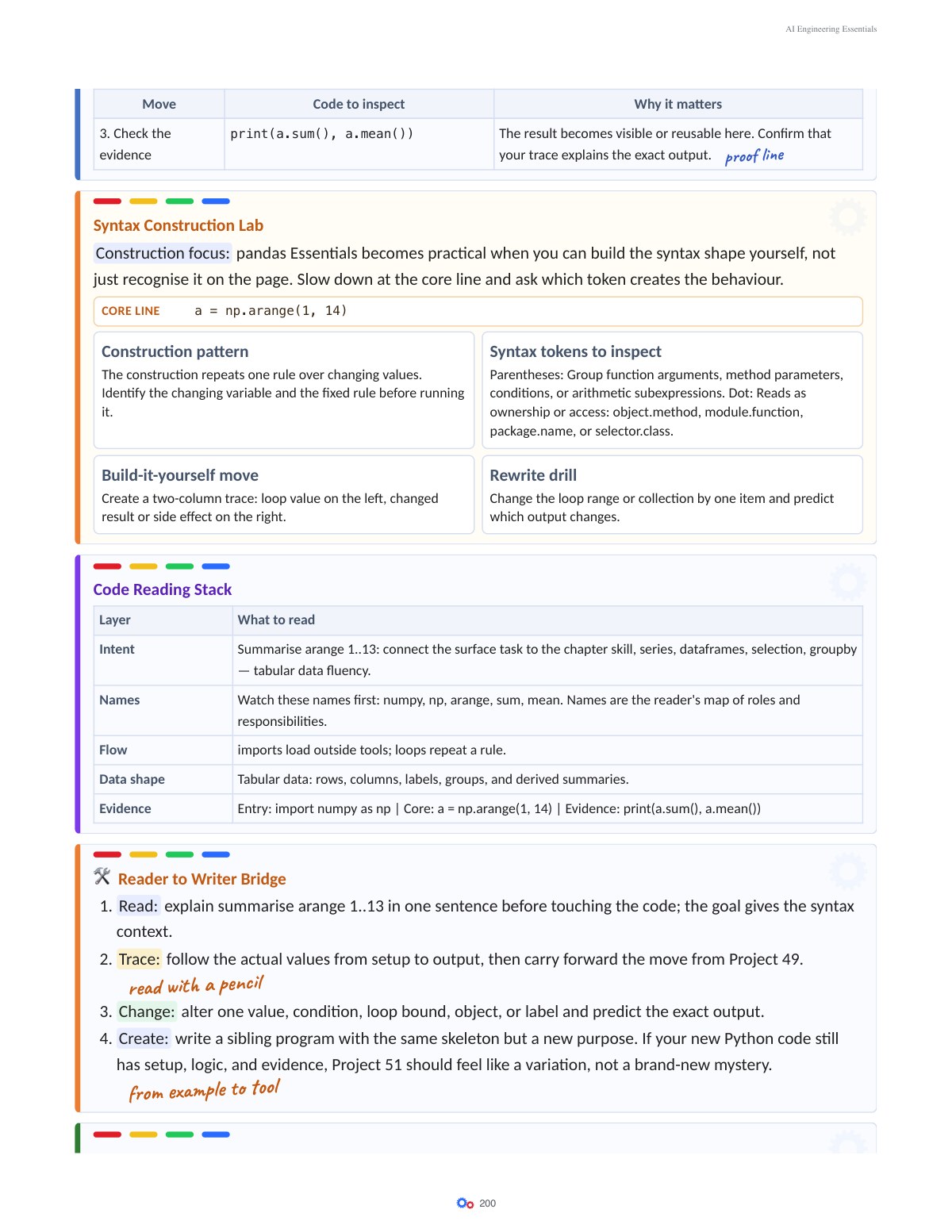
Scroll sideways through real pages from the latest PDF: the cover style, course rhythm, sample lessons, worked examples, and deeper reference material.

What it covers
The topic list gives a quick scan of the book's center of gravity before you buy.
More PDFs
How search really works now, and how to be found in it. 62 chapters taking a traditional marketer to working GEO practitioner.
View book
A 60-day Mandarin course with grammar reasoning, sentence maps, pinyin, characters, examples, review cycles, and daily quizzes.
View book
A 60-day German course that teaches spelling, articles, verb position, cases, clauses, style, and speaking control in small daily steps.
View book
A 60-day Japanese course from kana and particles to plain/polite forms, te-form, conditionals, voice, keigo, reading, and speaking.
View bookFrom the blog
Practical, no-hype articles that complement the book. Start here, then go deeper with the full PDF.
Questions
Yes. No advanced math is assumed. You should be comfortable with basic arithmetic and willing to install or use Python, but the book explains the needed data, metric, and model ideas as they appear. It is written for self-study and builds up step by step.
A realistic self-study pace is 8 to 12 weeks if you work through several lessons per week and actually run the projects. A faster reader can skim the early data chapters, but beginners should treat the book as a lab manual: read, run, inspect, and repeat. By the end, the reader should be able to reason about data preparation, classical models, neural-network basics, embeddings, RAG, evaluation, cost, scaling, and MLOps as connected engineering decisions.
AI Engineering Essentials is a 854-page downloadable PDF. After secure Stripe checkout you receive a private signed download link in your browser and by email, so you can start reading instantly.
Yes. It is a standard PDF you can read on a laptop, tablet, or phone, online or offline. It is a one-time purchase for $25 with no subscription — the file is yours to keep.
Book purchase
This checkout is for the PDF only. After payment, your private signed download link appears in the browser and is also sent by email.
Instant access to the complete 854-page PDF through a private signed download link.
Buy PDF for $25FulfillmentStripe